hyve logo
Home
work
Services
Case Studies
Blog
Robotics
Freebies
About
contact

Cinema 4D and Redshift: The Architectural Engine for Robotic Motion

Kaustubh Mishra

12 Aug, 2026 | 10 min read

Technology, CGI, Tools

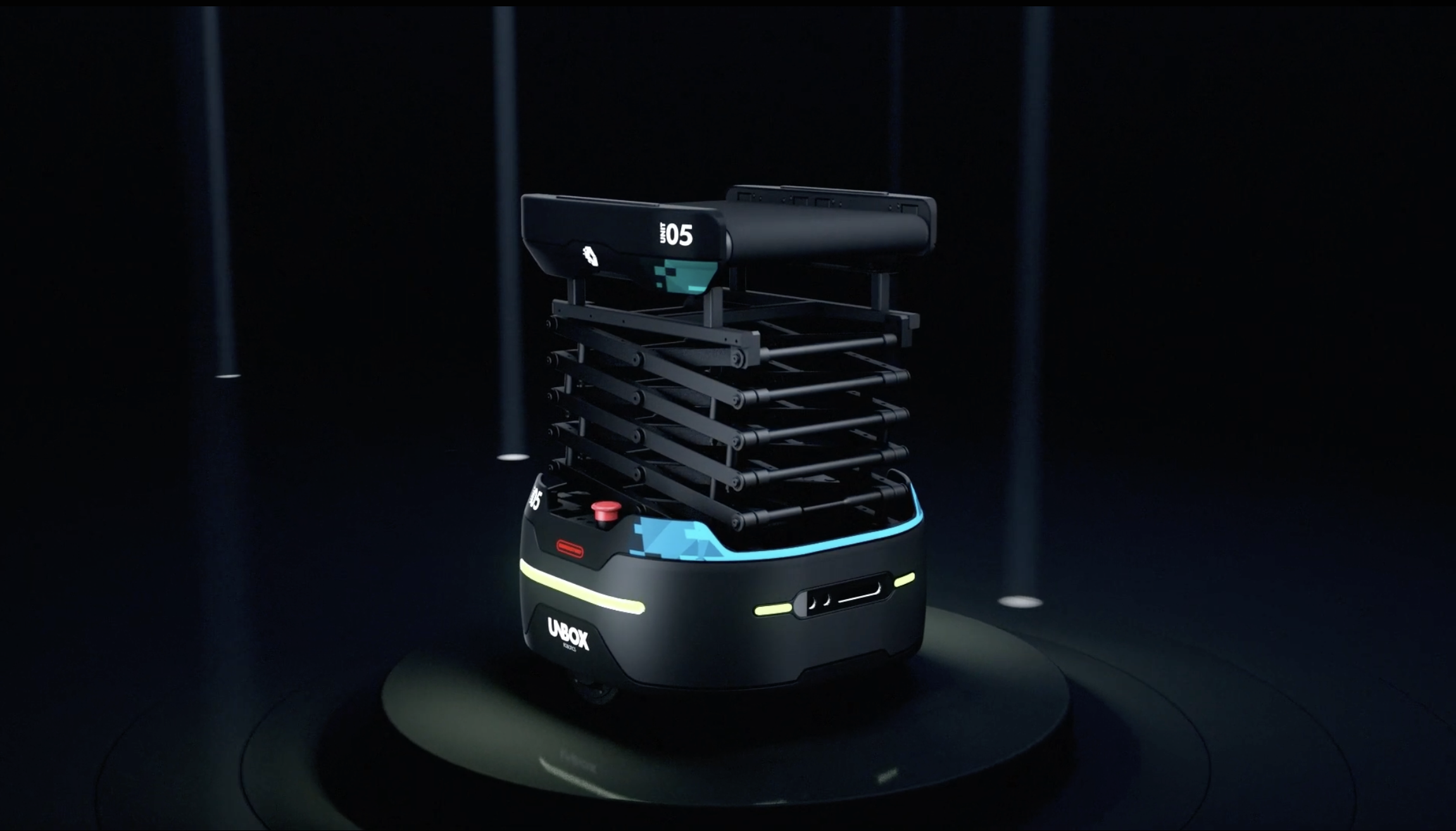
The biggest challenge in animating an automated warehouse isn't modeling a single robot, it’s populating a facility with 500 of them, each moving on independent paths without bogging down your computer's memory, while making it look realistic. Cinema 4D and redshift are uniquely built for this scale.

‍

Procedural Fleet Management with MoGraph

C4D’s MoGraph toolset acts as the virtual warehouse management system (WMS). Rather than hand-keyframing hundreds of AMRs, shuttles, and conveyor items, artists use procedural workflows:

‍

  • Cloners & Matrix Objects: Instantly generate massive arrays of storage racks, totes, and packages across thousands of square meters. Directly Import STEP/IGES CAD data to use as base objects.
  • Field-Driven Motion: Use Box or Spherical Fields attached to virtual "sensor zones" to trigger robotic arm rotations, conveyor belt speeds, or indicator lights dynamically as items pass through.
  • C4D Nodes & XPresso: Create logic-driven rigs where an AMR's wheels rotate automatically based on its travel distance, or where robotic gripper fingers clamp shut the exact moment a box intersects their hitboxes.

‍

Rigging Industrial Robotics

Whether it's a 6-axis articulated arm picking e-commerce items or an automated guided vehicle (AGV) navigating a bay, Cinema 4D’s Inverse Kinematics (IK) solvers make complex mechanical motion effortless. By setting up target controllers, you can animate a single target point in space, and the entire multi-jointed robotic arm folds, reaches, and rotates with mechanical precision.

‍

Out-of-Core Geometry & Instancing with Redshift

A fully detailed 3D warehouse containing millions of corrugated cardboard boxes, metal rack bolts, acrylic safety guards, and wiring harnesses will easily outgrow standard GPU VRAM.

‍

  • Redshift solves this through Out-of-Core memory management and Redshift Proxies.
  • You can animate and render a single hero AMR loaded with intricate internal components, convert it into a Redshift Proxy, and duplicate it 1,000 times across a field. Redshift renders the scene, in realtime, effortlessly while preserving full geometric detail.
‍
Physically Based Rendering (PBR) for Industrial Surfaces

Clean renders look fake. Hyper-realism lives in the subtle flaws of industrial environments:

‍

  • The Scratches Shader: Redshift’s procedural shaders can apply microscopic scuffs, brushed metal grain, and edge wear to yellow safety barriers and AMR bumpers without requiring custom texture painting.
  • Layered Materials: Create authentic surfaces using Redshift Material Blenders-combining a base coat of industrial powder-coated orange paint, a layer of oily grime near hydraulic joints, and a top layer of reflective clearcoat.

‍

Functional vs. Stylized Lighting

Industrial lighting is dynamic. Redshift’s GPU engine allows real-time feedback when setting up:

‍

  1. Atmospheric Volumetrics: Add a touch of Redshift Environment fog. As laser scanners and overhead high-bay lights pierce through the subtle ambient haze, you get cinematic light beams ("god rays") that instantly give the facility a vast, epic scale.
  2. LiDAR & Optical Visualizations: Use glowing Redshift emissive shaders paired with custom field sweeps to visualize the invisible data fields- like LiDAR sweeps, camera safety cones, and Wi-Fi telemetry-showing how the AI sees the floor.
  3. Generate Multi-pass AOVs (Depth, Emission, Diffuse, Motion Vectors) for ultimate control in post-processing.
‍

Using Cinema 4D and Redshift gives studios and internal visualization teams the speed to animate and iterate rapidly, and the visual polish to create standard-setting commercial content. By translating raw automation into cinematic art and animation, you turn complex robotic engineering into an unforgettable narrative of human ingenuity powered by machines.

‍

‍

No items found.

More Articles

Elevating Raw Engineering to Cinematic Brand Storytelling

11 Aug, 2026 | 7 min read
Explore
Explore
hyve studio arrow diaghyve studio arrow diag
see all articles
see all articles
hyve studio arrow diaghyve studio arrow diag

More blog articles coming soon! Please keep checking this page for updates. The articles, commentary, technical breakdowns, and creative opinions expressed on this blog belong solely to the respective writers and creators. These insights are shared for informational, educational, and inspirational purposes only. Animation techniques, industry standards, software pipelines, and market trends change rapidly. Therefore, readers must exercise due diligence and verify technical or business strategies independently before applying them to their own creative pipelines or commercial operations.

‍

See More
See More
hyve studio arrow diaghyve studio arrow diag
contact
Let's
Talk      
Sitemap
homeworkServicesCase StudiesBlogRobotics Freebiesaboutcontact
social
instagramYoutube
©
2026